Portrait of Tommaso Carraro

Tommaso Carraro, Ph.D.

Padova, Italy
>
Focus areas

Research interests

Recommender Systems Large Language Models Agentic AI Neuro-Symbolic AI
Tools I build with
PyTorch LangChain Ollama vLLM Qdrant Claude Code
Background

About

My passion for research started during my Master Degree at the University of Padova, with a project on Variational Autoencoders for top-N recommendation that became my first publication, at UMAP 2020. In 2021, after a year at Fondazione Bruno Kessler in Trento, I began a Ph.D. in Computer Science at the University of Padova, supervised by Prof. Fabio Aiolli (University of Padova) and Luciano Serafini (Fondazione Bruno Kessler).

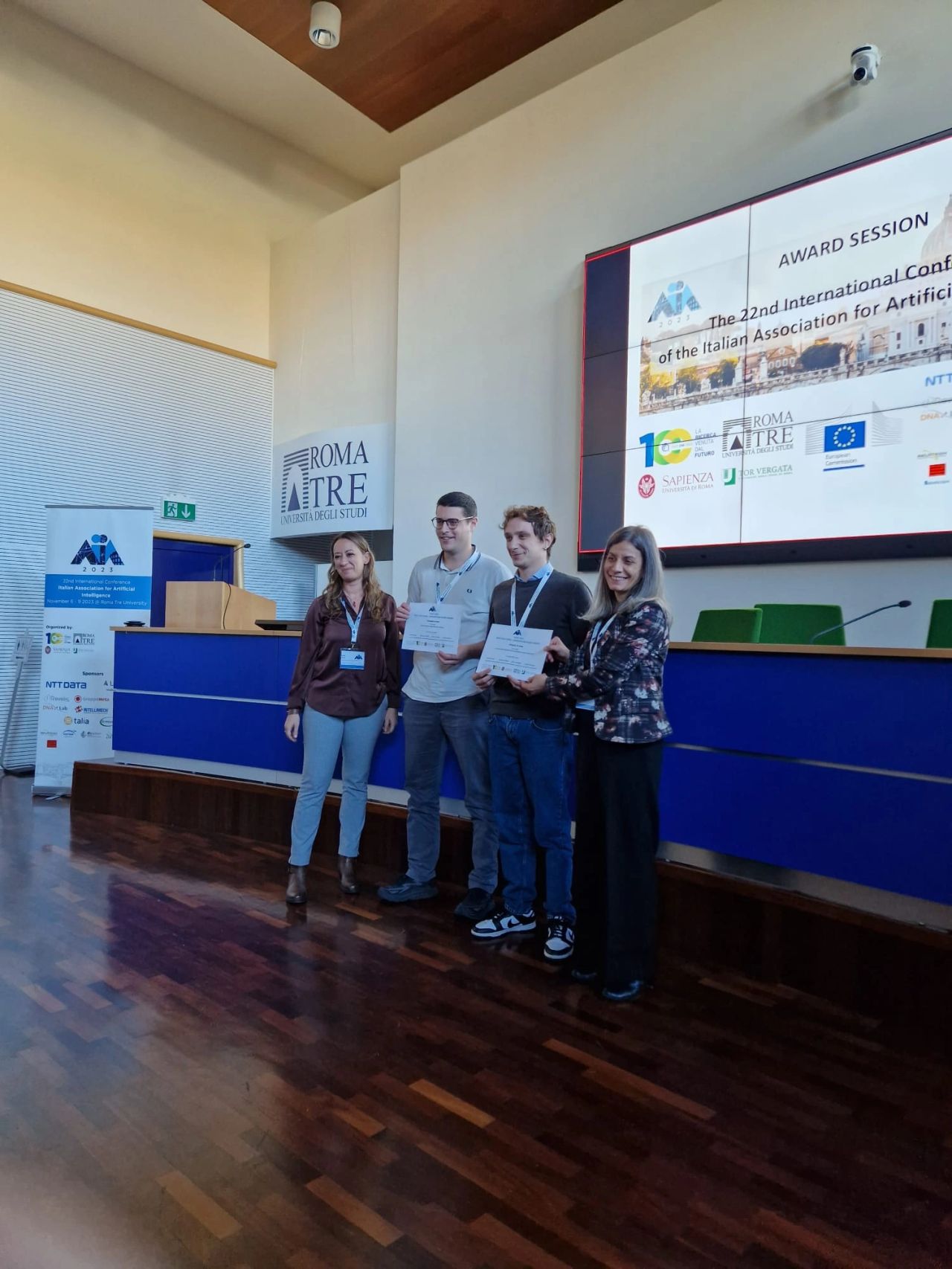
The Ph.D. centered on Neuro-Symbolic AI for recommender systems — combining neural networks with symbolic reasoning to tackle cold-start, data sparsity, and explainability. Along the way I published at ICANN, NeSy, ECIR, RecSys, and NeurIPS, spent a research period at the WISE Lab, Rutgers University (with Prof. Yongfeng Zhang), and won the Best Doctoral Consortium Paper Award at AIxIA 2023.

After graduating, I spent a year at Sony Research India and three months at Disney Research Zurich, both building LLM-powered recommender systems — an agentic recommendation system for Sony LIV, and a zero-shot LLM reranker for Disney+.

Things I've built

Projects

Selected work

Publications

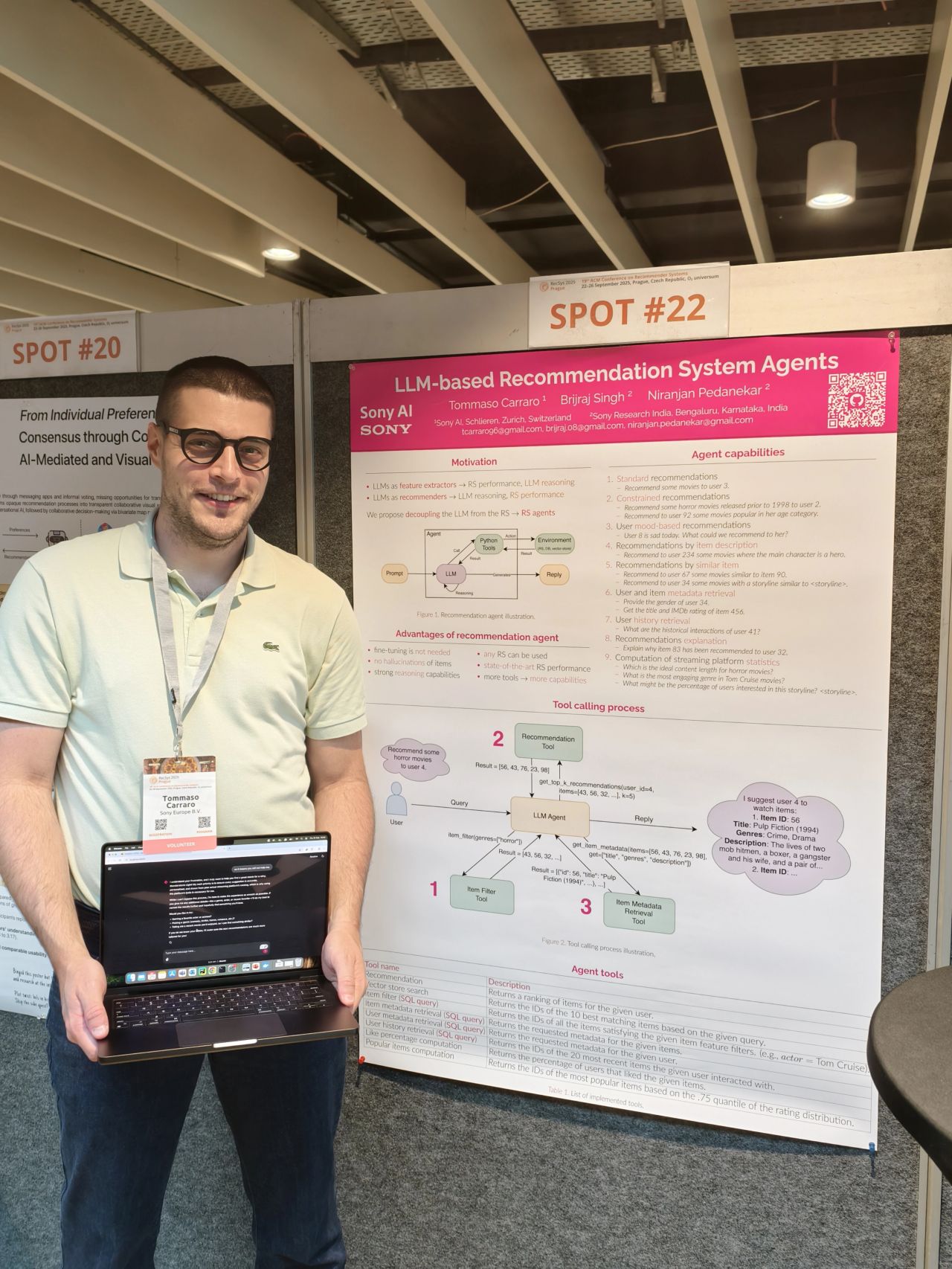
A Large Language Model-based agent is an AI assistant that makes use of advanced Tool Calling (TC) and Retrieval Augmented Generation (RAG) techniques to access external tools (e.g., Python code, databases). This allows the agent to consult additional sources of information that are complementary to its pre-trained knowledge.

Open Paper

We introduce rsbench, a benchmark suite designed to evaluate reasoning shortcuts (RSs): predictors that solve the downstream reasoning task without associating the correct concepts to the high-dimensional data. The benchmark provides customizable tasks and metrics for assessing concept quality in neural and neuro-symbolic models, and results show that achieving high-quality concepts remains an unresolved challenge across both approaches.

Open Paper

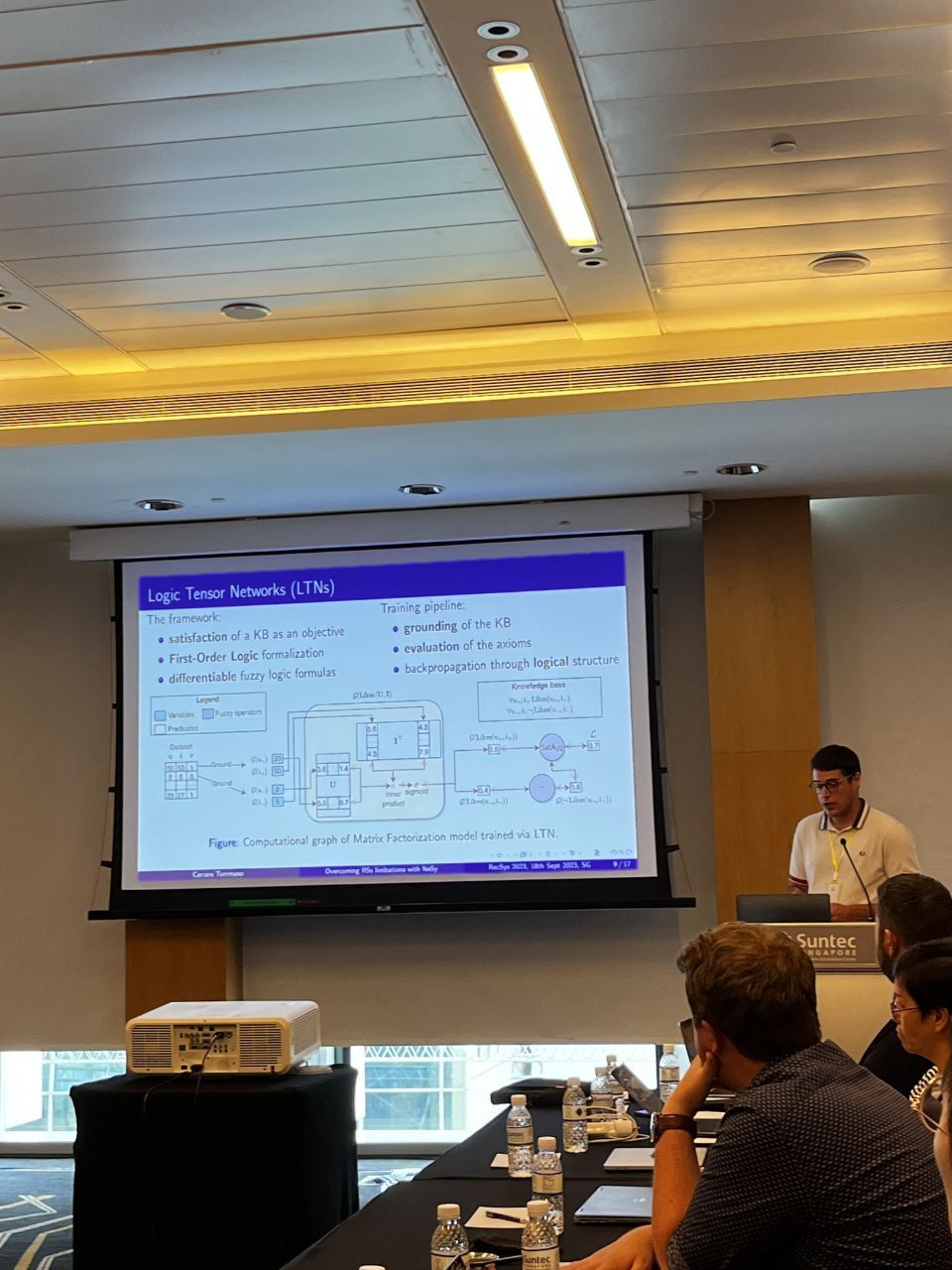
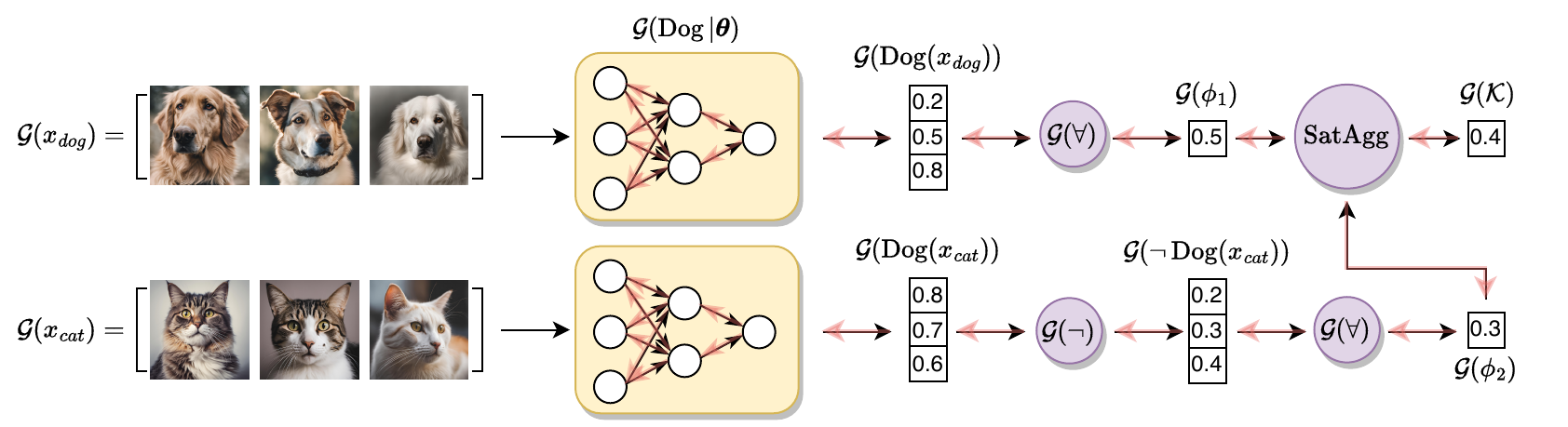
Logic Tensor Networks are a neuro-symbolic framework combining deep learning with logical reasoning. LTNtorch is the fully documented and tested PyTorch implementation of Logic Tensor Networks, enabling users to define logical knowledge bases as neural model objectives and learn through logical reasoning via gradient descent. The framework uses fuzzy logic to enable continuous truth values, making training via backpropagation feasible.

Open Paper

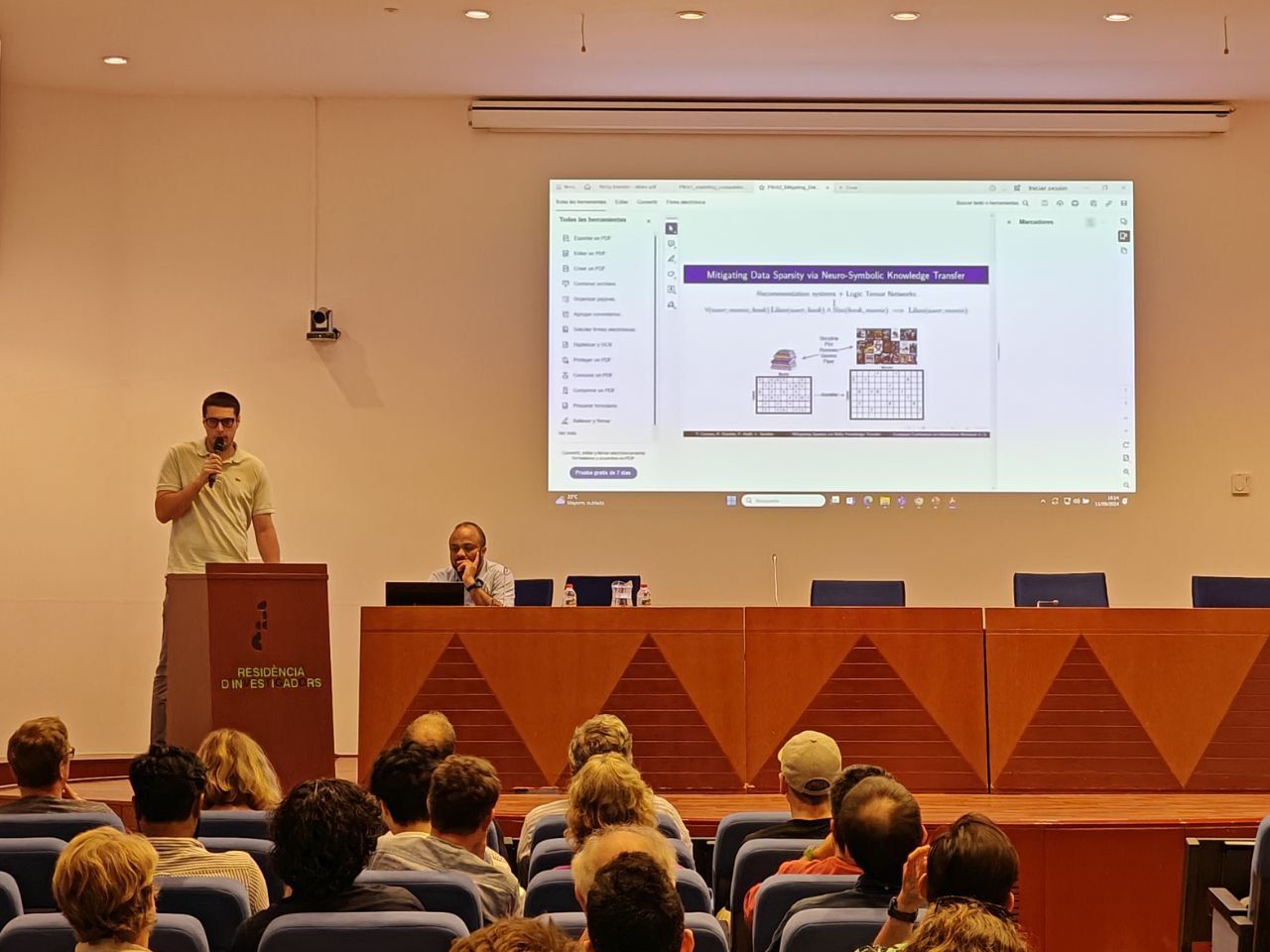
Data sparsity is a well-known historical limitation of recommender systems that still impacts the performance of state-of-the-art approaches. We propose a novel Neuro-Symbolic approach for knowledge transfer in recommender systems, using a Logic Tensor Network (LTN) to train a vanilla Matrix Factorization model for rating prediction. The benefits of the acquired knowledge increase with the sparsity of the dataset, showing the importance of exploiting knowledge from a denser source domain when training data is scarce in the target domain.

Open Paper

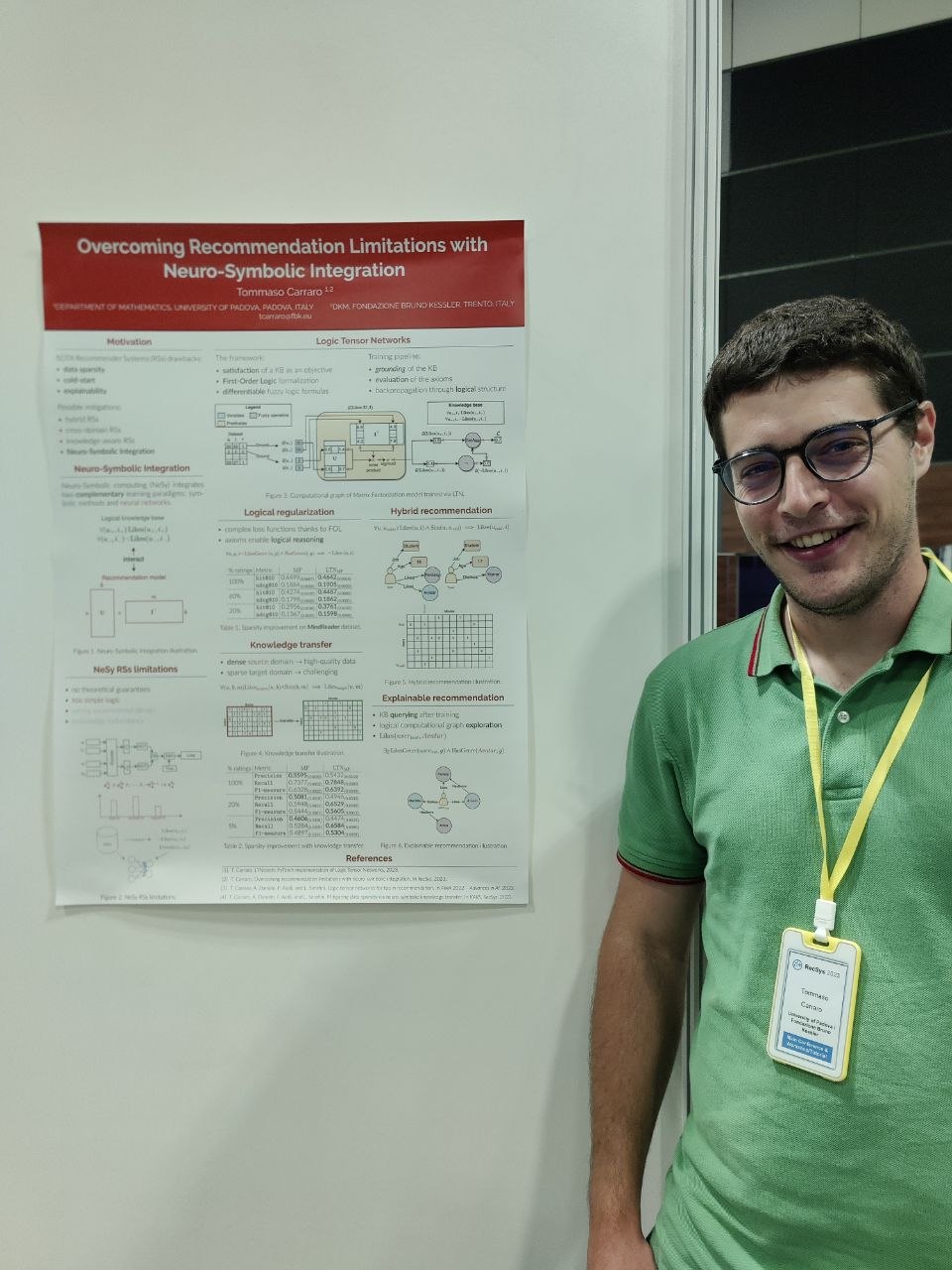
Recommender Systems still suffer from important issues that limit their applicability in real-world scenarios, with data sparsity, cold start, and explainability among the most impacting problems. These historical limitations can be mitigated by injecting prior knowledge into recommendation models. This work shows how Neuro-Symbolic integration via Logic Tensor Networks (LTN) can be used to regularize models, perform cross-domain recommendation, ensemble learning, and explainable recommendation, and to reduce popularity bias.

Open Paper

State-of-the-art recommender systems still suffer from important drawbacks which limit their usage in real-world scenarios, among them data sparsity and the cold-start problem. We propose to use Logic Tensor Networks (LTNs) to tackle the top-N item recommendation problem, showing how LTN can be used to easily and effectively inject commonsense recommendation knowledge into a recommender system. We evaluate our method on MindReader, a knowledge graph-based movie recommendation dataset, showing that the benefits of the injected knowledge increase with the sparsity of the dataset.

Open Paper

State-of-the-art recommender systems generally try to improve overall recommendation quality, but users often tend to explicitly filter the item set based on available categories (e.g., movie genres). We propose a Conditioned Variational Autoencoder (C-VAE) for constrained top-N item recommendation, where a condition vector is fed into the encoder and a new reconstruction loss takes the input condition into account. The model generalizes the state-of-the-art Mult-VAE collaborative filtering model, and experiments underline its potential for providing accurate recommendations under constraints.

Open Paper

Deep generative modeling enables new research directions but also raises ethical issues, as misuse can enable disinformation campaigns and phishing attempts, and biases in deep learning models can lead to misrepresentation. We formulate a novel setting to address these problems, showing that a repurposed anomaly detection system can effectively generate novel data while avoiding the generation of specified unwanted data. We propose Variational Auto-encoding Binary Classifiers (V-ABC), a model that repurposes and extends the Auto-encoding Binary Classifier anomaly detector using a Variational Autoencoder.

Open Paper

Interpretability is having an increasingly important role in the design of machine learning algorithms, though interpretable methods tend to be less accurate than their black-box counterparts. We propose an effective bottom-up extension of the FIND-S algorithm to learn DNF-type rulesets, greedily finding a partition of the positive examples into conjunctive rules. We also propose two principled extensions that approximate the Bayes Optimal Classifier by aggregating decision rules, along with a methodology to significantly improve explainability while retaining generalization capabilities.

Open Paper

Deep learning-based recommender systems currently lack explainability. We take a step toward filling this gap by providing an intuitive interpretation of the inner representation of a conditioned variational autoencoder (C-VAE) for collaborative filtering. The interpretation is performed visually, by plotting the principal components of the model's latent space learned on MovieLens data, showing that conditions on correlated genres map users into close clusters that enable the model to be used for profiling purposes.

Open Paper
Doctoral thesis
Neuro-Symbolic Recommender Systems
Tommaso Carraro · Ph.D. Thesis, University of Padova · 2025

My doctoral thesis on integrating Neuro-Symbolic computing with recommender systems, applying Logic Tensor Networks (LTN) to address data sparsity, cold-start, and explainability limitations through logical regularization, knowledge transfer, and cross-domain recommendation.

Talks

Webinars

Recommendation Systems — Lecture 006 of States of AI with Matteo Ciprian

A guest lecture covering the foundations of Recommendation Systems — core concepts, data representation, matrix factorization, and a look at where the field is headed — presented as part of a lecture series while I was a third-year Ph.D. student at the University of Padova / Fondazione Bruno Kessler.

Recognition

Awards & recognition

2024
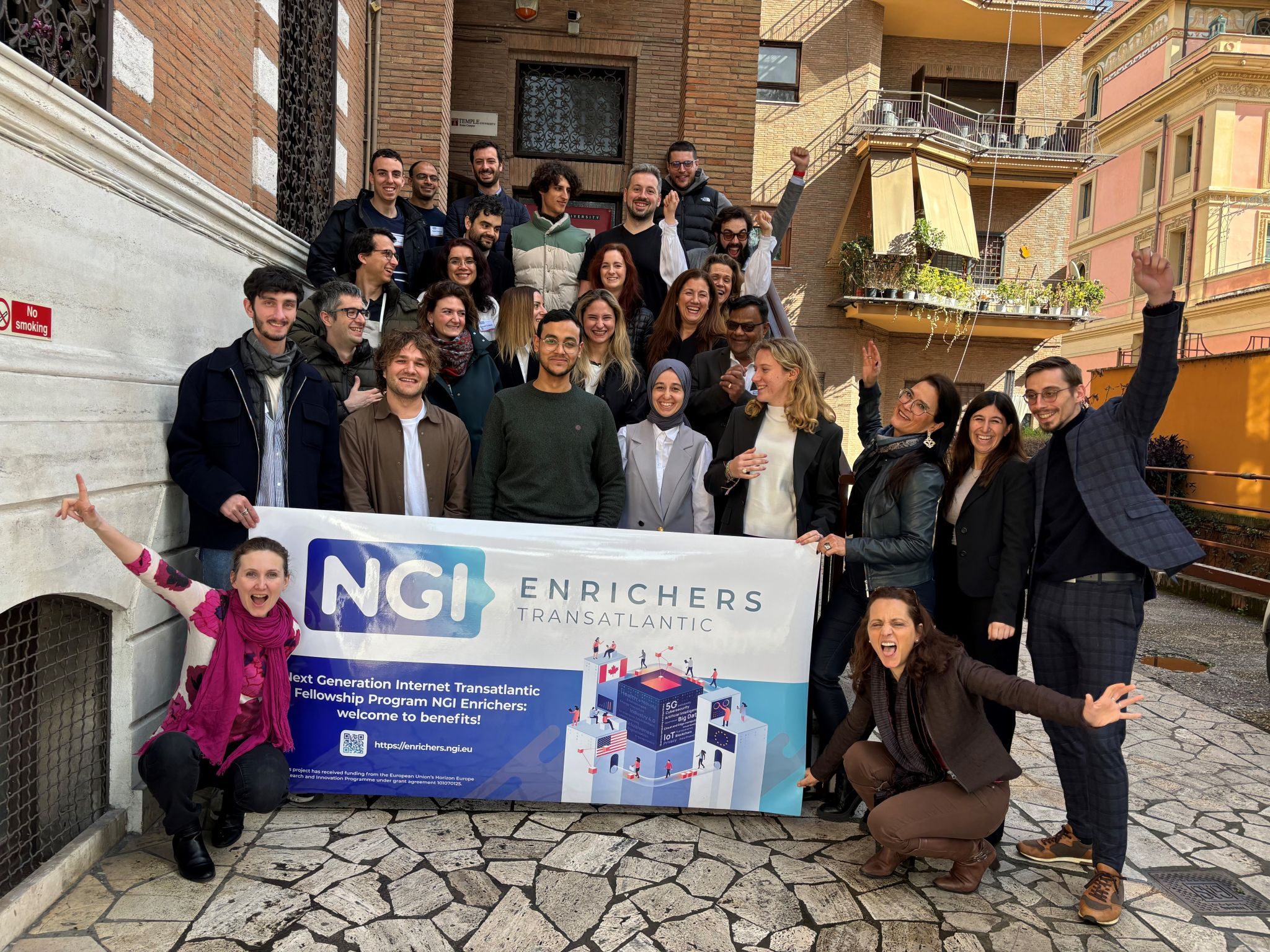
NGI Enrichers Fellowship
Funded research visit at Rutgers University, NJ, USA
2023
Best Doctoral Consortium Paper Award
AIxIA 2023
2016
"Mille e una lode" Scholarship
University of Padova

Get in touch

tcarraro96@gmail.com · Padova, Italy

References available upon request.